
Get Ahead with Marketing Trends for 2026
The marketing trends shaping 2026 and what businesses should be doing now
Marketing in 2026 will be defined by preparation and trust. Rapid changes in technology, particularly AI, alongside the change of consumer expectations, mean that reactive marketing is no longer effective. Businesses that plan ahead, invest in quality content and understand how audiences now discover information will be best placed to succeed.
This article outlines the key marketing trends expected to shape 2026 and explains what marketers should be doing now to stay competitive.
Design Office.
Generative Engine Optimisation (GEO) becomes a core marketing discipline
Search is no longer limited to traditional results pages. Google's introduction of AI Overviews and the increasing use of conversational tools such as ChatGPT, Microsoft Copilot and Gemini mean that users are receiving answers without clicking through to websites.
This has led to the rise of Generative Engine Optimisation (GEO), the practice of optimising content to appear in AI generated summaries and responses.
Unlike traditional SEO, GEO prioritises clarity, authority and structure over keyword density. Content must be easy to interpret and be factually accurate, and written with clear expertise. Google continues to emphasise Experience, Expertise, Authority and Trust (EEAT) as ranking signals, particularly for informational content.
For marketers, this means creating content that directly answers real questions and demonstrates subject knowledge. This approach should sit alongside ongoing SEO strategy and optimisation, rather than replacing it.
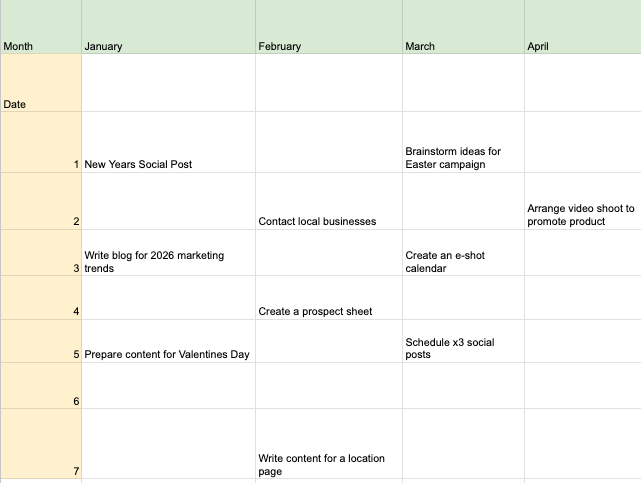
Planning this content in advance through a structured calendar also supports content marketing services ensuring key topics are covered consistently across the year.
Content quality overtakes content volume
The push to publish as frequently as possible is losing effectiveness. In 2026, content performance will be driven far more by usefulness than volume.
Research from HubSpot shows that long form, in-depth content continues to generate higher engagement and longer session times than short, low value posts. Search engines are also increasingly effective at identifying thin or repetitive content.
Rather than filling calendars with surface level posts, marketers should focus on producing fewer, higher quality assets that can be reused across channels. A single well researched article can support organic search, social media, email marketing and paid campaigns when planned properly.
This is where a joined up approach between content planning, copywriting and digital marketing services becomes essential.
First-party data becomes essential for personalisation
With third-party cookies continuing to be phased out and UK data protection regulations remaining strict, first party data will play a central role in marketing strategies for 2026.
Businesses will increasingly rely on data collected through their own websites, CRM systems and email platforms. Content plays a key role in encouraging voluntary data sharing through newsletters, downloadable resources and gated insights.
To do this effectively, marketers need content that provides clear value and builds trust. This should be supported by strong website design and development, ensuring data capture points are clear, compliant and user friendly.
Planning data led campaigns in advance also allows marketing teams to align content, email marketing and follow-up activity more effectively.

AI becomes embedded in everyday marketing workflows
In 2026, AI will be fully embedded into marketing workflows, supporting research, ideation, scheduling and performance analysis.
However, AI works best as an assistive tool rather than a replacement for human judgement. Generic or inaccurate content can quickly undermine trust, particularly in sectors such as education, public services and B2B.
Marketers should use AI to improve efficiency while maintaining editorial control, brand tone and factual accuracy. This balance is best achieved when workflows are clearly planned and supported by experienced professionals in creative design, copywriting and digital strategy.
Short form video remains dominant, but expectations rise
Short form video will continue to perform strongly across platforms such as Instagram, TikTok, YouTube Shorts and LinkedIn. UK data from Ofcom shows continued growth in video consumption across all adult age groups.
However, expectations are higher than ever. Audiences are less responsive to overtly promotional content and more engaged by informative, educational and authentic video.
Successful video marketing in 2026 will require proper planning, scripting and production. Content calendars should account for filming and editing lead times, particularly when video is part of a wider content marketing strategy or campaign rollout.
This is especially important for brands investing in video and photography services to support long-term marketing goals.


Brand trust becomes a deciding factor in marketing performance
Trust will continue to influence buying decisions across all sectors. Edelman's Trust Barometer consistently shows that consumers are more likely to engage with brands they perceive as transparent, knowledgeable and reliable.
This places greater importance on consistent messaging, realistic claims and evidence-led content. Case studies, testimonials and educational resources will play an increasing role in building credibility.
A long-term content plan allows brands to demonstrate expertise over time, supported by strong brand strategy, design consistency and messaging alignment.
Integrated marketing replaces siloed activity
Marketing channels can no longer operate independently. Audiences expect a consistent experience across websites, search, social media, email and offline touchpoints.
An integrated approach ensures that content supports multiple objectives without duplication. A single campaign can inform blogs, social posts, email marketing and print materials when planned strategically.
This level of coordination is difficult without a content calendar and a clear overview of activity across digital marketing, print and signage and campaign management.
Strategic planning outperforms reactive marketing
One of the most important trends heading into 2026 is a renewed focus on long-term planning. While agility remains important, constant reaction without structure leads to inconsistent output and missed opportunities.
Businesses that plan content months in advance are better positioned to adapt to algorithm changes, platform updates and market shifts without losing direction.
A content calendar provides the framework for this approach, supporting consistency while allowing flexibility where needed.
Preparing for 2026
Marketing in 2026 will reward businesses that plan with intent, invest in quality and build trust over time. Understanding emerging trends is only the first step. Implementing them through structured planning and integrated execution is where real advantage is gained.
At Design Office Ltd, we support businesses with content planning, SEO, creative design, websites and campaign delivery, helping brands stay visible and relevant in a changing digital landscape.
If you would like support preparing your marketing strategy for 2026, our team can help you build a content plan that is clear, practical and results-focused.
Tel: 01270 252106
Email: sales@designoffice.co.uk